|
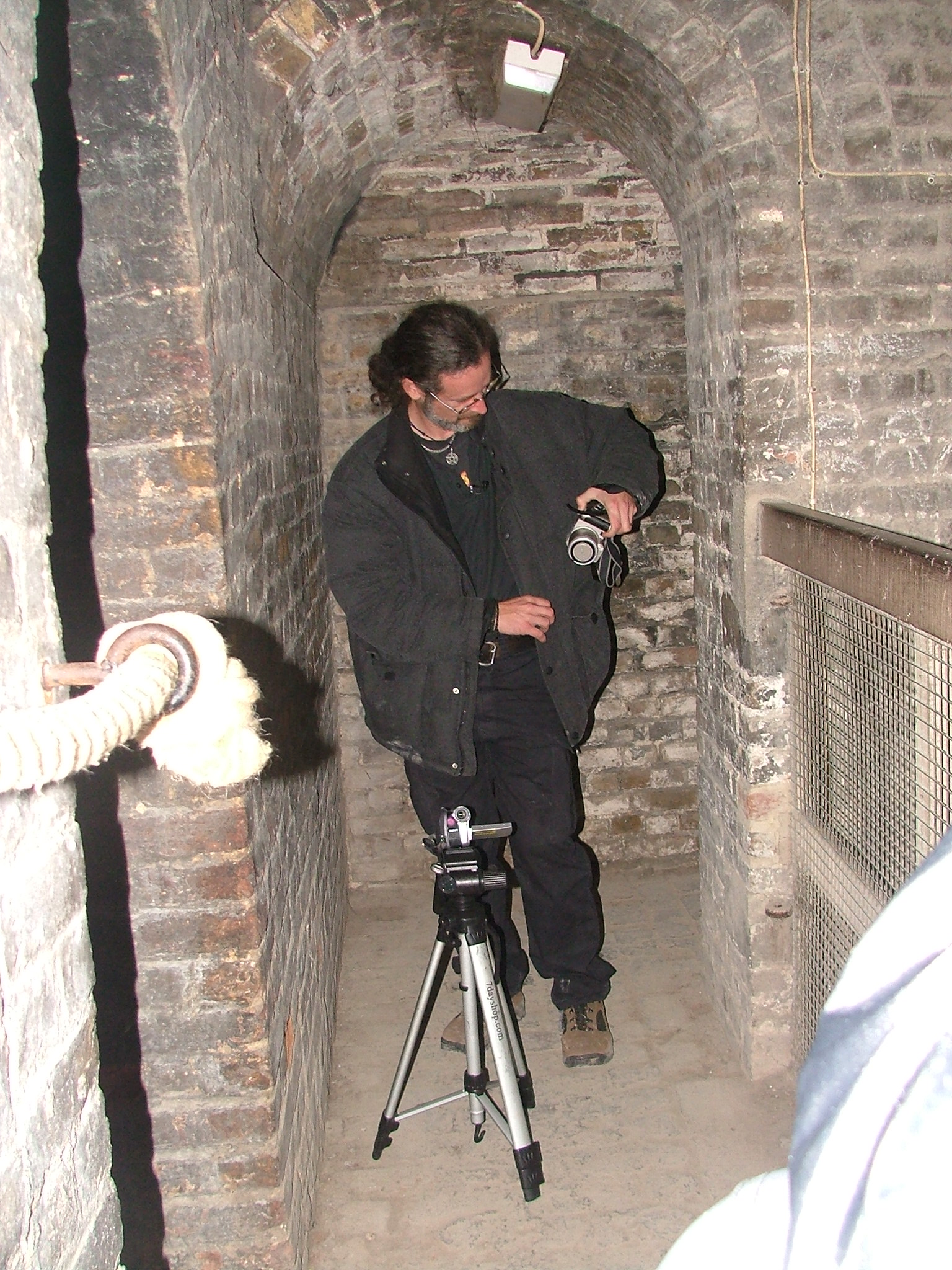
The series of photographs below were taken
with a Fuji Fine Pix S5000.
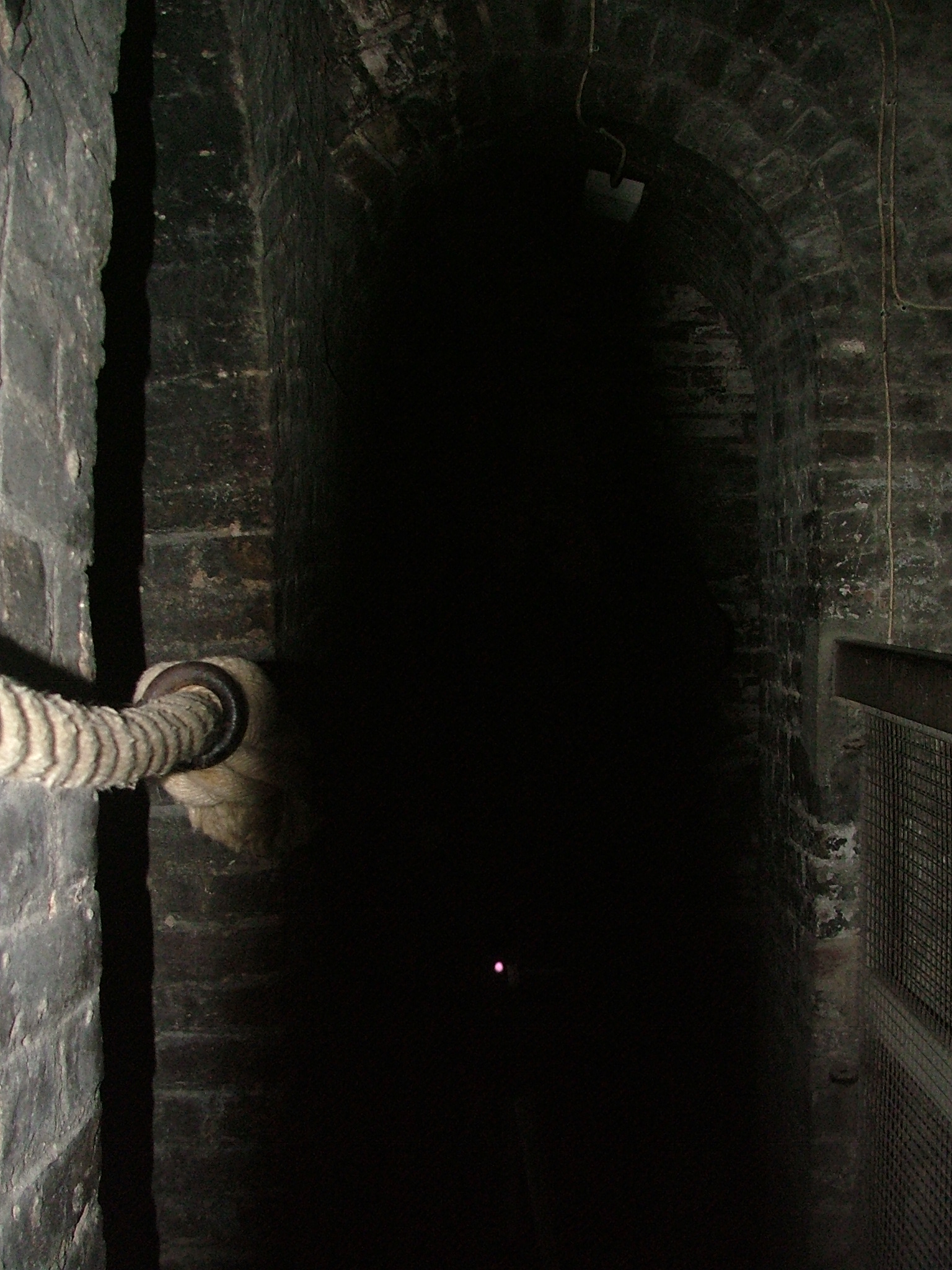
The series of pictures were taken in sequence one after the other in
quick succession. The first photograph fired correctly, the second the
flash misfired and the third resulted in a black mass.
We forwarded our pictures to other sources for comments, please read
their comments below. |
|
|
|
Interesting for sure, although unfortunately
not paranormal I think. Its probably caused by a flash misfire. When you
take flash photography there is a device called a capacitor which holds
a charge of electricity. This charge is an accumulation of charge, far
in excess of the actual battery strength. It needs to be very high voltage
to trigger such a bright light, even for a moment. It looks like the capacitor
misfired, and what you can see here is a half arsed attempt at flashing.
The light only illuminated the area over a much smaller distance than
a regular flash would have.
What at first appears to be a free standing black mass, is actually a
regular shadow which is extending away from the camera, quite possibly
on a 45 degree angle (hard to gauge exactly here, so best "guestimation")
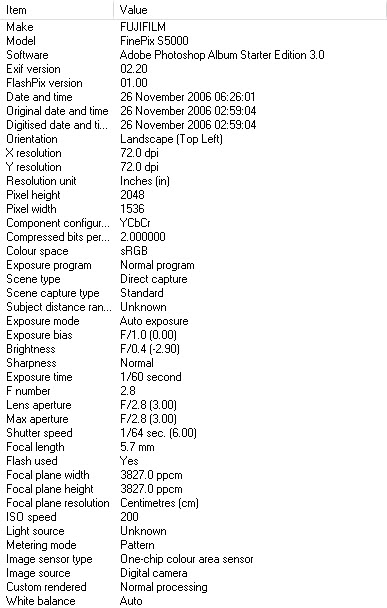
Looking at the Exif, reveals more important data. Here is a sample of
exif data for images ranging from 1 to 3
Image 1
Time taken: 02:59:04
ISOSpeedRatings 200
ShutterSpeedValue 1/64Sec
Flash : Fired(Auto)
Flash strength : -876595906/-1002605773
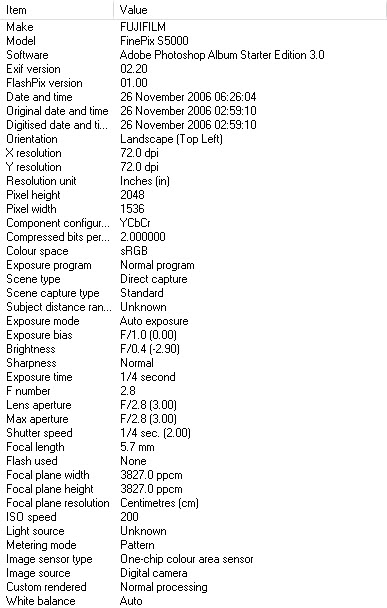
image 2
Time taken: 02:59:10
ISOSpeedRatings 200
ShutterSpeedValue 1/4Sec
Flash : Not fired(Auto)
Flash strength : 744904719/-976027393
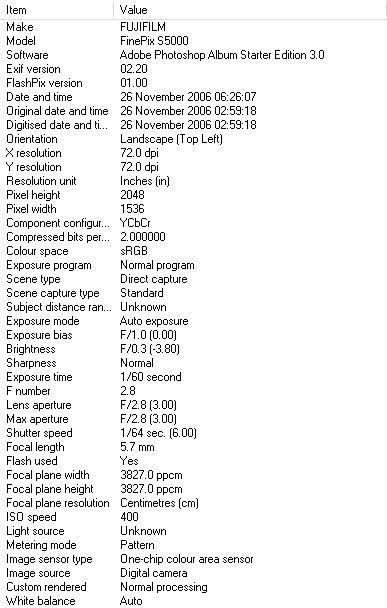
image 3
Time taken: 02:59:18
ISOSpeedRatings 400
ShutterSpeedValue 1/60Sec
Flash : Fired(Auto)
Flash strength : -328372497/1557029998
So what does this tell us?
Well on the third image (the shadow) the ISO speed had changed.
The second image has a longer exposure time because it was in complete
darkness.
The exposure time was oddly, not 1/64th of a second on image 3. Instead
a different setting altogether.
The flash strength settings on images 1+2+3 show a decrease over time
in strength.
It is my opinion, that it is simply a flash misfiring, due to a dodgy
capacitor charge. Although I must admit it does look very cool. It might
be worth sending that image to Fuji, so they can ascertain the actual
fault caused by the camera in that shot. It may be due to a broken part.
One thing you might find interesting though, I can prove there is nothing
between Ian and Dave at the end of the tunnel.
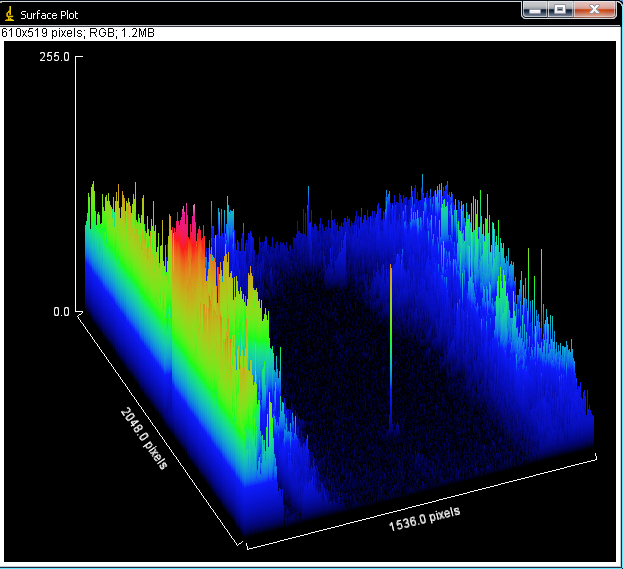
Take a look at the image below. I have software which can examine the
image as directly captured on the CCD chip. It will plot each point of
light from 0 to 255 (the full range from absolute black to pure white)
It presents it as an Isometric view (think of it like a picture that was
on the wall, now taken down and lying flat on the floor and turned slightly
to the left as you view it) This shows both walls, the arched ceiling,
and the single point of light (I assume infra red?) from the camera on
the tripod Dave set up. The single spike or peak of light is what is interesting
here. The fact it is the same length as the surrounding walls proves that
nothing impeded its journey to Ians camera, ergo nothing was between the
light source and the camera. The height spikes on the sides and top are
the actual walls, the blacked depressed area is the absence of light,
and the spike in the middle/bottom area is the IR

We thank Bob for his time and comments.
|
|
|
|
I've seen several examples of portals in photographic
analysis. Primarilly they are a form of energy and not an object but the
energy field is so intense that it shows up in a photo as a semi-solid
object. The reason that it shows in photos and is not visible to the eye
is that the energy in question is in a spectrum that we are not receptive
to. I was trained as an engineer and we constantly saw anomolies like
this during analysis of photographs. It's not exactly "common"
but it's common enough to be known. Most people write it off as a simple
energy anomoly.
The way I analyze photos is something that you should understand. First
of all, my software is not designed to identify the paranormal. It is
designed to eliminate any flaw, defect, error or unusual conditions that
can be identified by a database that Eastman Kodak has developed over
a period of over 40 years and updates regularly. I kept my copy of the
software when I retired from Kodak.It is not available commercially and
it requires a second computer (for me) simply to run those programs since
the memory capacity necessary is extensive. I still recieve the updates
from Kodak since I was a rather senior executive in the Overseas Division
when I retired.
Now... I have also assembled a database over the past 25 years or so that
contains known paranormal phenomenon and examples of verified incidents.
What I do is first run the photo through the software to eliminate any
chance of flaw or error of any kind that could exist. I then re-run it
and compare to the existing database on known paranormal phenomenon. My
goal is not to "prove" or "disprove" anything but
to actively identify what is actually in the photo. There are many cases
in which all I can say is that "it is not a flaw, error or any kind
of defect" but it is "unknown in origin and composition".
In this particular case, I had several fairly good examples of portals
in various stages of manifestation in my database and that is what this
most closely matches. My evaluations are always within a 5% factor +/-.
Even magnified to 1,200x it is impossible to tell exactly what you have
in that photo. However I can tell you this. Whatever it is, my software
indicates that it is a semi-solid object or mass of an "indeterminate"
form of energy. It is well within the focal range and limits of the camera.
It seems to be in the process of either materializing or dematerializing,
Likewise, analysis indicates that it is definitely an object that is
part of the photo and not any known flaw, defect or error. The software
that I use is designed to eliminate all known flaws, errors and defects
as well as identify any known user error. None of these register in analysis.
This is a genuine anomoly.
We thank Doctor Choron for his time and comments.
|
|
|
|
Thank you for sending the sample images It
would appear from the images that the image sensor on the camera has developed
an intermittent fault causing the black area on the image.
We have contacted Fuji again and asked them to explained themselves
in more detail! Their next reply;
The image sensor (CCD) is the light capturing sensor on the camera, when
the image sensor becomes defective, one of the symptoms can be a complete
or partial black image. Image sensors can develop intermittent faults
so although you have only experienced this problem once it is possible
it can happen again.
We were expecting a more substantial reply!
|
|
|